When a Mother's Mind Becomes a Place She No Longer Recognizes
When we talk about having a baby, most of the conversation is about the baby. How much did the baby weigh? Is the baby sleeping? Are you breastfeeding? Who does the baby look like? Is the baby eating enough? Everybody wants pictures, everybody wants to hold the baby, and everybody wants to know how the baby is doing.
Meanwhile, standing in the middle of all of this is a woman who just went through pregnancy, childbirth, physical recovery, major hormonal changes, sleep deprivation, and a complete change in her everyday life. Yet, somehow, one of the simplest and most important questions can get lost in everything else: How is Mom really doing?
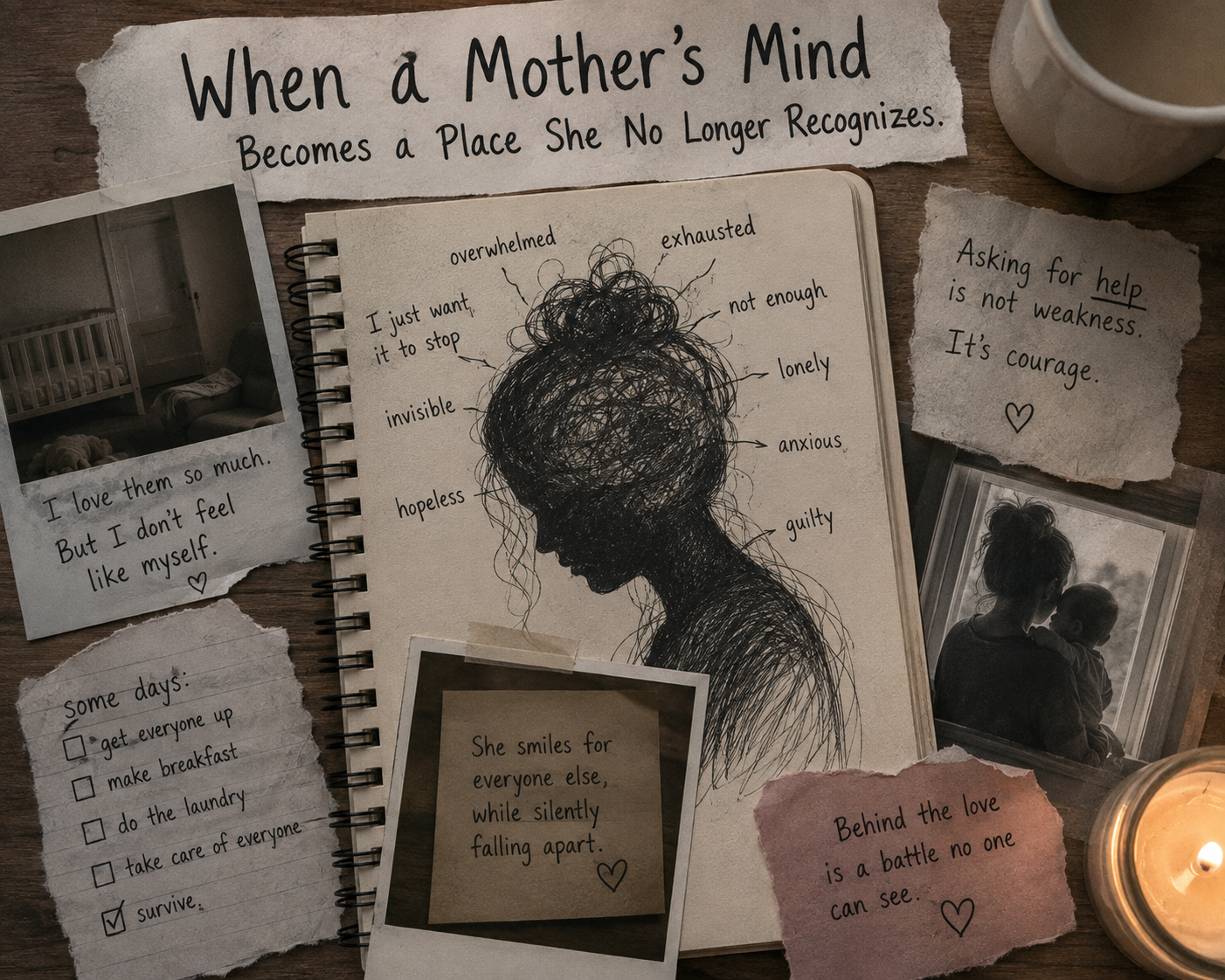
I do not mean casually asking, “How are you?” while already expecting her to say, “I’m fine.” I mean really asking her. Are you sleeping? Are you eating? Are you overwhelmed? Do you feel like yourself? Are you anxious? Are you crying when nobody is around? Are you having thoughts that frighten you? Do you feel connected to your baby? Do you feel hopeless? Are you enjoying motherhood, or are you simply surviving one day at a time?
Sometimes we become so focused on whether a woman is taking care of her baby that we forget somebody needs to take care of her too.
This subject is personal for me because I experienced postpartum depression myself. After having my daughter, I was eventually diagnosed with postpartum depression and social anxiety. I went through therapy and was prescribed Zoloft, also known as sertraline. Looking back on that period of my life, there are things I understand now that I probably could not completely understand while I was living through them.
Sometimes you do not realize how far away from yourself you have traveled until you finally begin finding your way back. That is one of the reasons I feel so strongly about talking about postpartum mental health today. My experience is part of my story, but it does not define me as a mother.
Before experiencing depression myself, I probably had the same picture of depression that many people have. Someone is sad. She cries constantly. She stays in bed. She cannot function.
But depression does not always look that way.
A woman can get dressed, take care of her children, go to work, cook dinner, laugh at a joke, post beautiful family pictures, and tell everybody she is fine while something completely different is happening inside her. Postpartum depression can involve sadness, but it can also involve anxiety, irritability, guilt, hopelessness, difficulty concentrating, exhaustion, trouble bonding, changes in sleep and appetite, feelings of worthlessness, and, in severe cases, thoughts about death, self-harm, or suicide.
NIMH notes that most episodes of perinatal depression begin within roughly four to eight weeks after birth, although symptoms can begin during pregnancy or later in the postpartum period. (National Institute of Mental Health)
Imagine that for a moment. Imagine being a loving mother who wanted her children, loves her children, and would normally do anything to protect them, but somewhere along the way, she starts feeling like a completely different person.
Depression begins telling her that she is worthless. Anxiety tells her something terrible is constantly about to happen. She cannot sleep even when she finally has the opportunity. Her thoughts race. She feels guilty for not being happier. She starts believing everybody would be better off without her. Maybe she becomes afraid of being alone with her thoughts. Maybe thoughts about death begin appearing. Maybe she starts thinking about hurting herself.
That transformation is one of the things people who have never experienced severe depression sometimes have difficulty understanding.
That brings me to one of the hardest parts of this conversation: How does mental illness sometimes result in self-harm or suicidal thinking?
Severe depression can change the way someone evaluates herself, her future, and her circumstances. Hopelessness can become so overwhelming that the person has difficulty imagining that what she is experiencing will ever end. Depression can convince someone that she is a burden or that her family would be better without her.
Those thoughts are symptoms that deserve immediate attention, not evidence that she does not love her family. Research on maternal self-harm has identified underlying psychiatric disorders, including depression, as important risk factors for both suicide and substance misuse, and the postpartum period is recognized as a particularly vulnerable time. (PubMed)
Substance use can become part of this story too. Not everyone experiencing depression or anxiety will use alcohol or drugs, but some people attempt to self-medicate emotional pain. A person who cannot sleep may drink because she wants her brain to shut off. Someone experiencing severe anxiety may use a substance because, for a few hours, she feels calmer. Someone dealing with depression may be searching for anything that temporarily changes how she feels.
The danger is that temporary relief can turn into dependence, worsen depression or anxiety, interfere with treatment, and increase impulsivity or risk. What began as an attempt to escape emotional pain can create another problem on top of the original illness.
This is why I do not believe we should look at a struggling mother and simply ask, “Why is she drinking?” or “Why is she doing this to herself?” We should also be asking what she is trying to escape from, what symptoms were there first, whether she is receiving appropriate treatment, and whether anyone has noticed that she is deteriorating.
Another question I have had is whether mental illness is hereditary. The answer is more complicated than a simple yes or no. Mental illnesses such as depression and bipolar disorder can run in families, but they are not inherited in a guaranteed way.
NIMH explains that perinatal depression has no single cause and that genetic and environmental factors can contribute. A personal or family history of depression or bipolar disorder can increase risk. Bipolar disorder also has a significant hereditary component, but many genes are involved, and having a relative with bipolar disorder does not mean someone will definitely develop it. (National Institute of Mental Health)
I think of genetics as one piece of a much larger puzzle. You can have genetic vulnerability and never develop a particular disorder. Then pregnancy, hormonal changes, stress, trauma, sleep deprivation, relationship problems, financial stress, lack of support, or other circumstances may interact with that vulnerability.
This is why knowing family mental health history should probably be treated more like knowing family history of diabetes, high blood pressure, or heart disease. We routinely ask about those conditions, but how many of us know whether our mother, grandmother, aunt, or sister experienced serious depression after childbirth?
Maybe previous generations did not even have the language for it. Grandma had “bad nerves.” Somebody had a “breakdown.” Somebody was “not herself” after having a baby. Somebody stayed in the house for months. Somebody cried all the time. Somebody became extremely anxious.
We cannot diagnose previous generations based on family stories, but we also should not assume mental illness did not exist simply because nobody talked about it.
For years, we also heard depression described as a “chemical imbalance.” That phrase made depression sound almost too simple: one brain chemical is low, medication corrects it, and everything is fixed.
Modern research does not support such a simple explanation. A major review of the serotonin theory found that the evidence does not establish depression as simply the result of low serotonin. That does not mean antidepressants do not work. It means their effectiveness should not be reduced to the old explanation that they simply replace a missing chemical.
Depression involves a much more complicated interaction of biology, brain function, genetics, psychology, environment, and life experiences. (Nature)
Postpartum mental health adds another major biological event: childbirth itself. During pregnancy and after delivery, the body undergoes significant hormonal changes. NIMH identifies hormonal changes, the physical and emotional demands of childbirth, caring for a new baby, life stress, and genetic and environmental factors as contributors to perinatal depression. Researchers are also studying why certain women appear particularly sensitive to reproductive hormonal changes. (National Institute of Mental Health)
Then add sleep deprivation. Add breastfeeding or pumping. Add physical recovery. Add another child who still needs attention. Add work. Add bills. Add a relationship that is changing. Add a baby waking every two hours. Add another pregnancy soon after the last one, and the demands can become even greater.
Having children close together does not automatically cause postpartum depression, and it would be inaccurate to say that “back-to-back babies” create a chemical imbalance. But repeated pregnancies can mean repeated hormonal transitions, prolonged sleep disruption, physical recovery, and greater caregiving demands. For someone who already has risk factors, those additional stresses deserve attention.
This is also why fathers cannot be treated as supporting characters in postpartum recovery. I recently had a conversation with men who talked about how their mothers worked ten-hour days, came home, cooked dinner, helped with homework, cleaned the house, and basically handled everything.
My immediate thought was: Okay, but were they okay?
We know Grandma cooked. We know she cleaned. We know she worked. We know she raised her children. But do we know what happened when she closed her bedroom door? Do we know what she cried about? Do we know whether she was depressed or anxious?
Functioning is not always evidence that somebody is mentally healthy.
And I think we have to stop saying fathers “help” with their own children. A father changing his baby’s diaper is parenting. Getting up during the night is parenting. Making bottles is parenting. Taking the baby so Mom can sleep is parenting. Cooking dinner is parenting. Knowing the pediatrician’s name is parenting. Knowing when diapers are running low is parenting. Knowing that your wife has barely slept in three days is being a partner.
The mental load matters too. Sometimes Mom does not need somebody to ask her, “What do you need me to do?” because now she has another task: managing the person who is supposed to be helping her.
Look around. Wash the bottles. Make dinner. Take the baby. Handle the older children. Call her mother. Give her three uninterrupted hours of sleep. Ask her how she is feeling and actually listen to the answer.
Extended family has a role too. If a woman is repeatedly saying, “I need help,” believe her before she has to prove how badly she needs it. Do not tell her every mother is tired. Do not tell her Grandma had six children and survived. Do not tell her to pray harder, toughen up, or be grateful because she has a healthy baby.
Gratitude and depression can exist at the same time. Love and anxiety can exist at the same time. A woman can adore her children and still need psychiatric treatment.
Medication can be an important part of that treatment. Depending on the person’s symptoms and diagnosis, clinicians may consider other antidepressants, psychotherapy, or different psychiatric medications. There are also treatments specifically approved for postpartum depression. (U.S. Food and Drug Administration)
But medication is not one-size-fits-all. The medication that helps one woman may not help another. The correct dose for one patient may be inappropriate for someone else. Side effects matter. Other medications matter. The underlying diagnosis matters.
And this becomes especially important when bipolar disorder may be involved. NIMH notes that if bipolar disorder is mistaken for depression, antidepressant treatment without an appropriate mood-stabilizing treatment can sometimes trigger mania or rapid cycling. (National Institute of Mental Health)
That does not mean antidepressants are dangerous or that psychiatric medication should be feared. Medication can be lifesaving. I personally took Zoloft as part of my own treatment. What it means is that medication requires proper diagnosis, follow-up, and monitoring.
That leads to the uncomfortable question: Who is to blame if somebody is overmedicated, misdiagnosed, or given medication that is not helping?
I do not think there is one universal answer. Medicine is complicated, and an unsuccessful medication does not automatically mean a doctor committed malpractice. Psychiatry often requires evaluating symptoms over time and adjusting treatment as more information becomes available. Patients can also respond differently to the same medications.
But healthcare professionals do have a responsibility to listen, assess risk, review symptoms, consider medication interactions and side effects, monitor changes, and reassess when a patient is getting worse instead of better.
Families also have a role. The patient has a voice. If somebody says, “This medication is making me feel strange,” “I am getting worse,” “I haven’t slept,” “I’m having suicidal thoughts,” or “I don’t feel safe with myself,” those statements should never be brushed aside.
A prescription should not be the end of the conversation.
The question should not simply be, “Did she get help?”
The better question is, “Was the help actually helping?”
My earlier writing about postpartum treatment kept returning to this distinction because technically receiving treatment does not necessarily mean the illness has been adequately controlled. Sometimes a diagnosis needs to be reconsidered. Sometimes medication needs to be changed. Sometimes a second opinion is appropriate. Sometimes outpatient treatment is no longer enough. Sometimes hospitalization is necessary.
And this is where we have to separate postpartum depression from postpartum psychosis.
Postpartum psychosis is rare, generally estimated at around one to two cases per 1,000 births, and it typically develops very quickly after childbirth. It can involve hallucinations, delusions, paranoia, mania, severe confusion, and a loss of contact with reality. It is a psychiatric emergency. (NCBI)
Research has also established an important relationship between postpartum psychosis and bipolar-spectrum illness, and family history of bipolar disorder or postpartum psychosis can be particularly relevant when assessing risk. (PubMed)
That distinction is critical because the overwhelming majority of mothers with postpartum depression do not harm their children. Intrusive thoughts can also occur without a woman wanting or intending to act on them. We should never create a situation where a mother is too afraid to tell her doctor about a frightening thought because she assumes everyone will immediately think she is dangerous.
Psychosis is different because a person’s perception of reality itself may become impaired.
And that forces us to ask:
What impact does mental illness have on the decisions being made?
What happens when a loving parent becomes so severely ill that depression, mania, delusions, hallucinations, or suicidal thinking begin influencing the way she sees herself, her children, or reality? What happens when someone who would normally protect her children with her life no longer processes information the way she normally would?
This question does not excuse violence, erase accountability, or suggest that people with mental illness are dangerous. Most people with mental illness are not violent. But there are rare psychiatric emergencies in which judgment and perception can become profoundly impaired.
Andrea Yates remains one of the most devastating examples. Medical literature describing her history documented serious psychiatric illness, psychosis, suicidal behavior, and religious delusions before she drowned her five children in 2001. Her case became an important part of the medical discussion surrounding postpartum psychosis and infanticide because there had been serious warning signs and previous psychiatric treatment before the tragedy. (Psychiatry Online)
The Lindsay Clancy case raises some of the same questions today, although it must be discussed differently because her criminal trial is still ongoing as I write this in August 2026. Clancy killed her three children in 2023 and then attempted suicide. Her defense argues that severe postpartum mental illness affected her responsibility, while prosecutors argue that the killings were deliberate.
Family testimony during the current trial has described suicidal thoughts and significant mental-health concerns before the deaths. Because the medical and legal interpretations remain disputed, I do not think any of us should diagnose her from a distance or claim that medication, postpartum psychosis, or any single factor has been proven to have caused what happened. (Reuters)
But the case raises a question worth asking.
What happens when someone asks for help, takes medication, sees professionals, and still continues deteriorating?
We cannot look backward at every tragedy and automatically blame one doctor, one prescription, one spouse, or one missed appointment. But we can learn something from these situations: mental-health treatment needs follow-up. Families need education. Doctors need accurate information. Patients need to feel safe telling the truth.
And when somebody’s behavior changes dramatically, we cannot keep assuming everything is ordinary postpartum exhaustion.
If a mother is becoming severely confused, paranoid, disconnected from reality, hearing or seeing things that are not there, expressing suicidal intent, unable to sleep for prolonged periods while becoming increasingly agitated, or behaving in ways that are completely unlike herself, the people around her should not wait for the next routine appointment. Postpartum psychosis requires emergency psychiatric evaluation. (National Institute of Mental Health)
I keep coming back to the loving mother because that is what makes this conversation so difficult. People see a tragedy and ask, “How could a mother do that?” It is an understandable question.
But maybe there is another question medicine and society need to ask alongside it:
What was happening to that person’s mind when those decisions were being made?
Was she processing reality normally? Was she psychotic? Was she severely depressed? Was she suicidal? Was she using substances? Was there an undiagnosed bipolar disorder? Had she stopped sleeping? Had her medication recently changed? Had she told somebody she was getting worse? Did somebody dismiss what she said? Were there warning signs? Did the family understand what those warning signs meant?
Sometimes there will be answers. Sometimes there will not.
What I do know is that we cannot continue waiting until a mother is completely falling apart before deciding she deserves help.
Motherhood does not protect someone from mental illness. Love does not cure depression. Being grateful does not cure anxiety. Having a supportive husband does not guarantee a woman will never experience postpartum depression. Medication does not mean somebody is weak. Therapy does not mean somebody has failed. And asking for help does not make somebody less of a mother.
My own postpartum depression and social anxiety are part of my story. Therapy is part of my story. Zoloft is part of my story. But none of those things define my ability to love my children.
If anything, what I went through changed how I see mothers now.
I think about the woman smiling in the family picture who has been crying every night. I think about the woman whose husband believes she is “just tired.” I think about the mother who is terrified to admit she had an intrusive thought because she thinks someone will take her baby away. I think about the woman pouring another glass of wine every night because it is the only time she feels like her mind slows down. I think about the mother who has been telling everybody, “Something is wrong with me,” while everybody keeps telling her she is fine.
And I think about the women who never said anything at all.
That is why we have to keep talking.
Ask Mom how she is doing after the baby is born. Then ask again two weeks later. Ask again three months later. Ask again when everyone else has stopped visiting and returned to their normal lives. Ask when she goes back to work. Ask when the baby still is not sleeping. Ask when she has another baby and now has two or three small children depending on her every minute of the day.
And fathers, partners, and families need to understand that sometimes loving somebody means doing more than telling her to get help. It means helping her get there. It means going to the appointment. It means telling the doctor what you have observed when she cannot explain it herself. It means taking the baby so she can sleep. It means removing some of the responsibilities from her shoulders instead of waiting for instructions. It means noticing when the woman you know suddenly does not seem like herself.
Most importantly, it means listening when she says:
“I need help.”
Those may be three of the most important words a mother ever says.
And instead of asking why she cannot handle motherhood the way women supposedly did generations ago, maybe the question we should finally be asking is:
How can we make sure she does not have to handle all of it alone?
Because maybe women today are not weaker. Maybe the hormones did not suddenly change. Maybe depression did not suddenly appear. Maybe anxiety did not suddenly appear. Maybe mothers generations ago struggled too.
Maybe the biggest difference is that we are finally willing to hear them.
We should not be afraid of that conversation.
We should be afraid of what can happen when nobody has it.

Founder / Mental Health Advocate
Nikiya “NikiMarie” Jeffries, formerly known as Nikiya Rodriguez, is a media creator, mental-health advocate, and higher-education professional whose voice and storytelling continue to inspire and uplift diverse audiences. She is the creator and host of NikiMarie Radio, The Balancing Act: Highs, Lows and Lessons, Mentality Mondays, and several developing multimedia projects centered on healing, culture, and emotional growth. Her work reflects a unique blend of creativity, empathy, and dedication to helping people feel seen and understood.
Born and raised in New York, NikiMarie has always been guided by a deep passion for communication and community connection. Professionally, she serves as the Assistant Director of Financial Aid. In this role, she supports students through the complexities of federal aid, FAFSA requirements, verification, loan counseling, and compliance. Known for her clarity and compassion, she has become a trusted resource for students who rely on her ability to break down complicated information with ease and patience.
In media, NikiMarie’s warm presence and relatable storytelling resonate across radio, podcasts, and digital platforms. Her shows, heard on 90.3 WHPC and major streaming outlets, explore themes such as mental health, relationships, burnout, identity, parenting, and personal transformation. Through honest reflection, humor, and research-based insight, she creates a safe space where listeners can learn, heal, and grow alongside her. Many admire her ability to discuss difficult topics with authenticity, depth, and heart.
… Read More