
 Apple Podcasts

 Spotify

 Spreaker

 Deezer
S02 E03: Breaking the Cycle: Healing While Raising Children

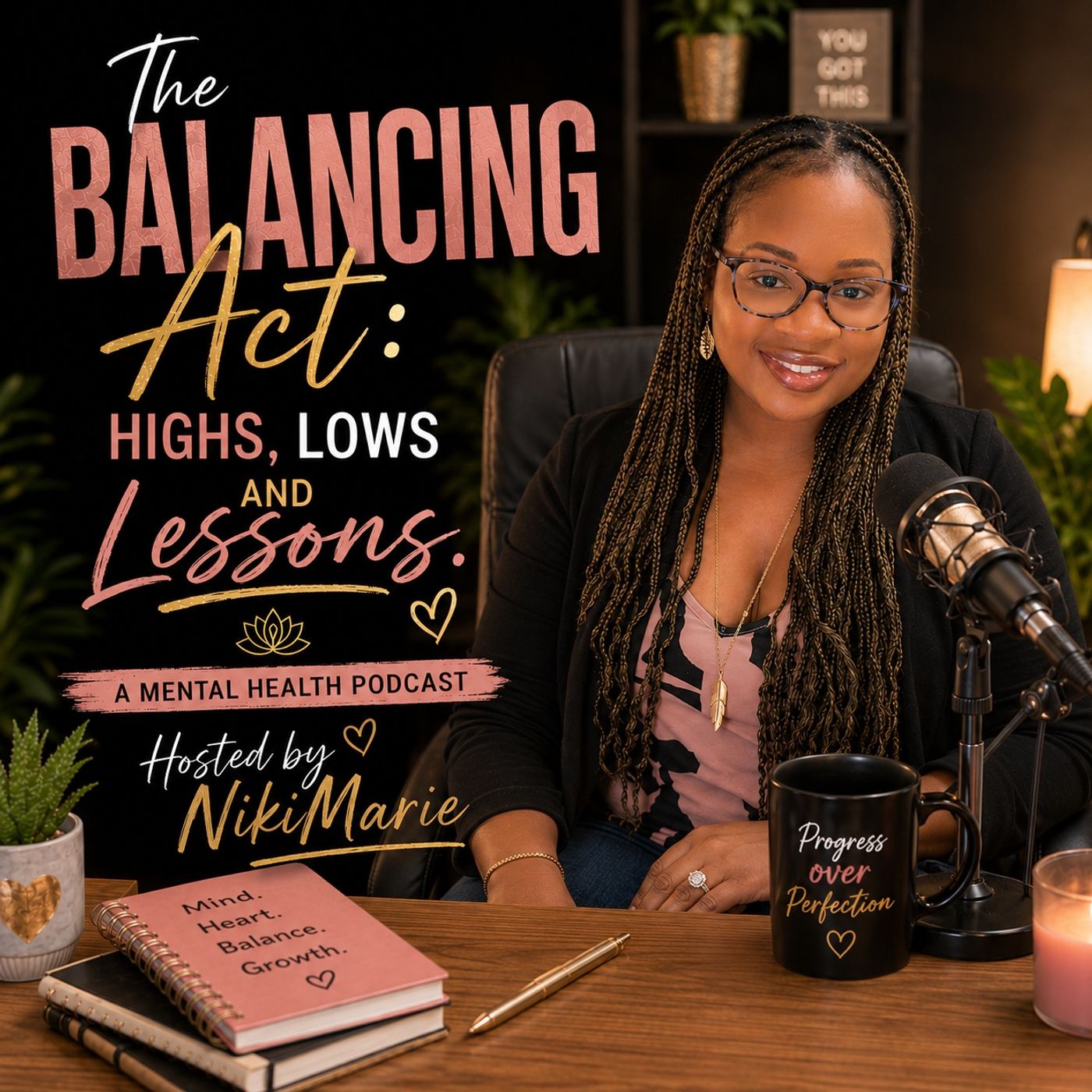
Welcome back to The Balancing Act. Today’s episode is one every parent should hear. Niki invites listeners into a raw and honest conversation about parenting while healing, something so many people experience but rarely admit out loud. It is the tiredness you feel before the day even begins. It is carrying emotions you never had time to unpack while still pouring love into your children. It is doing everything for your family while quietly trying to rebuild yourself.
In this episode, Niki opens up about her own healing journey and the powerful moments her children witnessed along the way. They saw her vulnerable. They saw her take care of her mental health. They saw her grow. And those moments became lessons: that strength is not silence, that emotions are real, and that healing is something you are allowed to choose for yourself.
Listeners will explore the emotional weight parents carry, the instinct to give more when you already feel empty, and the truth that children feel everything even when you say nothing. Niki also explains how small, intentional moments can interrupt generational patterns and create a home where emotions are understood instead of feared. This episode is heartfelt, comforting, and truly transformative. If you are a parent who keeps going even on your heavy days, this conversation will speak directly to you. Tune in and let yourself breathe.
Hosted by NikiMarie, a Mental Health Advocate and Radio Personality for Nassau Community College Radio Station, 90.3 WHPC. The Balancing Act explores the highs, lows, and lessons of everyday life, reminding listeners that balance comes from presence, peace, and giving yourself grace.
0:10 Hello, and welcome back to the Balancing Act. I'm your host, Nick Marie, and I'm really glad you're here. Today we are diving into something so many parents feel but rarely speak out loud. Now. Parenting takes patience, energy, and heart. Parenting while you're healing, while you are working through depression, anxiety, or old wounds you never had time to face, is a different kind of journey. I know because I've lived it. I had seasons where I was doing my best for my kids while carrying emotions that felt heavy and complicated. But what mattered most was that my kids saw me. They saw me vulnerable, they saw me take care of myself, they saw me grow. I want them to understand, and I've always wanted them to understand that mental health health is real, Healing takes time, and asking for help is strength. Today we're talking about cycles, the silent weight parents carry, and how we build a healthier emotional world for the next generation.
1:18 There is a kind of emotional weight that parents carry that we almost never talk about. It doesn't make a sound and it doesn't always show up on your face, but you feel it. It lives in your body. It sits in your thoughts. It shows up in the quiet moments when the house is finally still and you realize just how tired you really are. A lot of parents know this feeling, especially parents who are trying to heal while raising kids. Healing from depression, healing from anxiety, healing from things you never got to unpack, healing from loss or heartbreak, or just healing from years where you were living in survival mode. When you're a parent going through your own healing, it adds a whole extra layer of emotional responsibility to everything you do. I want to talk about what that actually feels like, in a real, honest and vulnerable kind of way. There are mornings where you wake up and your first thought is I am already tired, like you have nothing else to give, But not because you are doing anything wrong, but because you're carrying emotional weight from yesterday, or last week, or even years ago.
2:34 Your mind feels foggy, your body feels heavy, and even the simplest things feel like a lot. But you get up anyway. The kids always need something, right, I mean, you get up because your child needs breakfasts. You get up because someone needs their hat, or someone needs their hair done, or someone need their backpack zipped up. You get up because there's. A permission slip to sign or a lunch to pat. Parenting doesn't pause just because your spirit feels worn out. And from the outside people see you doing what needs to be done. You look functional, you look responsible, you look like everything is under control. People might even say I don't know how you do it, and you smile and keep going, even though you honestly don't know how you do it either, But somehow you do. That is the silent weight, the emotional loads sitting under every routine, the heaviness that stays with you even when you haven't said a word about it. Now, let's talk about what that looks like emotionally, because it's not just tiredness. Sometimes it's sadness. Sometimes it's fear. Sometimes it's anxiety that shows up for no clear reason. Sometimes it's an old memory rising back when you thought maybe you were past it.
4:02 Sometimes it's self doubt. Sometimes it is simply the pressure of showing up for everyone else while you're still learning how to show up for yourself. And here's the part that is hard for a lot of parents. You do not want your kids to carry your emotions, so you end up hiding them. You put on a smile, you power through, You say I'm fine even when you're not, and you tell yourself you'll deal with it later. Except later usually becomes much later. So let me paint a picture for you. Imagine a parent going through depression. They still get their child ready, They still show up to school events, they still help with homework, they still laugh at the silly moments. They are present, but inside they feel drained or overwhelmed. They push through because their child depends on them, but that emotional sits on their chests all day. And here's the thing.
5:06 Kids feel emotions before they understand them. They may not know the words depression or anxiety or burnout, but they know when something feels different. They notice when your voice is softer. They notice when you move a little slower. They notice when you are not as playful or your eyes look tired. They can't explain it, but they feel it. Children pick up emotional shifts we don't even realize we're showing. This is why communication matters so much for parents who are healing. Not heavy grown up conversations, just simple honesty.
5:52 There have been times when I had to say to my kids, I'm having a heavy day, but I'm taking care of myself, and that oneence does much. It tells them the feeling is mine and not theirs. It tells them they don't cause it. It tells them adults have feelings too, and it also tells them I know how to care for myself. That is how you protect them without pretending. A lot of parents think hiding every emotion is good parenting, but parents who are healing learned that small moments of honesty actually creates more safety. When you name your emotions, even briefly, your kids are not left guessing.
6:41 You take the confusion away, you take the pressure away. This is where healing starts to show up in parenting. Healing is not about acting perfect. Healing is about creating a home where emotions are allowed, where feelings are not scary, where kids learn that people can have heavy days and still be loving and studying. Healing is not a straight line. Some days you feel grounded. Of the days you feel like you are piecing yourself together before breakfast. But every time you acknowledge your emotional reality, the weight gets a little lighter, and something beautiful happens. Your kids become more emotionally aware. They learn empathy, They learn curiosity instead of fear.
7:31 They learn that love does not require pretending. They learned that being human is not something to hide. Now Here is what every healing parent needs to hear. The silent weight you carry is not a sign of weakness. It is not a sign that you are failing. It is proof that you are healing while still showing up and that strength. But that silent weight can lead to something else that many parents struggle with, overcompensation. When you feel like you're not giving enough emotionally, you start giving more in other ways. You try to do everything. You push yourself past exhaustion. You try to make up for what you think you're lacking, even though you already know that you are given too much. When the silent weight becomes too heavy, parents start to overcompensate without realizing it.
8:27 So let's talk about what. That looks like, why it shows up, and how we shift from doing everything to being more present. Let's take a break and get into that next layer. Something many parents never say out loud but feel deeply is the urge to overcompensate. And let me start by saying this. There is no manual for raising children. None and my dad would say that to me very often. We're all figuring it out as we go. We are learning in real time. We make decisions based on our past, our fears, our hopes, and the promises we made to ourselves long before we even had kids.
9:14 Parenting is the most important job we will ever have, and somehow it is the one job that comes with no step by step instructions. Funny over compensation often comes from a place of love, of course, but it also comes from fear. It comes from parents who grew up without emotional safety, parents who were never allowed to talk about their feelings, parents who were punished for crying or ignored when they were hurt. Parents who had to learn how to survive emotionally, not express themselves. Some parents make a silent promise early on, my children will never feel what I felt, And because of that promise, they try to become everything they needed as child, but all at once, all the time, even when it stretches them too thin.
10:07 Let me give you a picture of what this looks like. Imagine a parent who grew up in a strict, emotionally closed home. Feelings were not discussed, tears were not welcome. Vulnerability was seen as disrespect or weakness. So this parent grew. Up learning to be quiet, strong, and self contained. Now fast forward to them as an adult with children of their own. Instead of repeating the environment they grew up in, they swing to the opposite extreme. They buy everything their child wants, They say yes to everything, They try to prevent any disappointment or discomfort. They bend over backwards to keep their child happy, and even when they are exhausted, they pushed through because they want to give their child a different experience. Now, on this it looks like love, and it is, but underneath it there is fear. Fear of not being enough, fear of repeating the past, fear of hurting their child the way they were hurt, feeling of failing. But here's the truth that can be hard to face. Over compensation usually leads to burnout. I mean, yeah, granted, yeah, that's pretty much. I mean, it turns parenting into a performance.
11:30 You start feeling like you constantly have to prove something. You feel guilty when you can't keep up. You feel overwhelmed because you are trying to feel your own childhood emptiness through your child's experiences and while your intentions comes from a pure place, the impact can be confusing for a child. A child who never hears no does not learn boundaries. A child who never experiences a little dis appointment does not build resilience. A child who is shielded from every uncomfortable emotion does not learn how to navigate their own emotional world. What children truly need is much simpler than perfection. They do not need a parent who gives them everything. They need a parent who is emotionally present.
12:21 They need structure that gives them stability. They need boundaries that make them feel safe. They need connection that teaches them what love actually looks like and feels like when you think about it. Children are not looking for the perfect parrot. And my son said this to me the other day. He's like, Mom, there's no perfect parent. They are looking for the consistent one, the available one, the steady one, the one who tries over Compensation is not failure. It is a signal. It is a sign that healing is needed. And the healing does not come from doing more, or buying more, or staying yes more. Healing comes from shifting your mindset, from moving out of performance mode into the connection mode. So Instead of asking how can I make sure my child never feels what I felt? The real question becomes how can I guide my child through their feelings in a healthier way than anyone guided me.
13:28 That is where the real transformation happens. Because parents do not break emotional cycles by overgiving. They break cycles by modeling emotional health. They show their children what calm looks like, what accountability looks like, what repair looks like, what honesty looks like, what boundaries look like, what emotional safety really feels like. And that is the next part of this journey. Once you stop trying to be perfect and start trying to be present, you begin to model emotional intelligence without even realizing it. That is when the real change happens, not just in you, but in your child, in your home, and your entire family line. Really, so, let us move into the next layer, what it really means to model healthy emotional behavior. As a parent who is still healing, I think we can all agree that children watch everything.
14:32 They watch what you say, how you say it, and what you do when no one else is paying attention. They learn from your tone, your reactions, your silence, and the way you recover when things get hard. Whether you realize it or not, your emotional behavior becomes their blueprint. Kids are not looking for a perfect parent, They are looking for a human one. They learn how to handle their own emotions by watching how you handle yours. When we talk about modeling emotional intelligence, what we mean is showing your child what it looks like to move through feelings with awareness instead of fear. Healthy coping does not mean you never get upset or overwhelmed. It means you acknowledge your feelings and choose a mindful response instead of reacting from a place of chaos. Imagine you have a long day, right you're tired, your patience is wearing thin, and your child does something that pushes your last button.
15:40 Your instinct might be to snap. Many of us grew up seeing that kind of reaction, that quick, sharp, automatic. But instead you pause, You take a slow breath, you put a hand on your chest, or take a step away, and you say I need a minute because I want to respond calmly. That moment is so powerful. Now you just modeled self awareness, emotional regulation, and you modeled what control actually looks like. Your child learns that emotions can show up without causing destruction and The truth is, these habits take time. No parent gets this right every day.
16:30 Healing is definitely a process, and learning healthier coping strategies is a process. And remember that your child is always watching, not to judge you, but to learn from you, and that's. A process too. Let's talk about some healthy ways you can model emotional intelligence in your home. Healthy coping strategy one is to name your emotions. Something as simple as saying I'm frustrated or I'm feeling overwhelmed right now teaches a child that emotions are normal and manageable. Healthy coping Strategy two. Using body awareness, you can say, my shoulders feel tight and that's letting me know I need a break, or my heart is beating fast, so I'm gonna breathe. Children understand physical cues long before emotional ones. Healthy coping Strategy three.
17:31 Taking micro breaks walking into another room, splashing water on your face, stepping outside for fresh air, or sitting quietly for one minute teaches your child that slowing down is a tool, not a weakness. Healthy coping strategy four. Healthy self talk. Even whispering to yourself, I can handle this gives your child an internal script for when they faced their own challenges. Healthy coping strategy five, showing how you calm down now, whether that's breathing, stretching, journaling, praying, playing music, or grounding yourself. Letting your child see you use these coping tools teaches them to build their own now. Another key piece of emotional intelligence is emotional repair. Every parent will have their moments where they react too quickly or say something that they wish they didn't, and that's normal.
18:40 What matters is how you handle what comes after. There have been times where I react in a way I wasn't proud of. I was overwhelmed, I raised my voice, I shut down, But I went back to my kids and said, I'm sorry, I was having a hard time and I'm working on it. That simple act taught more than a perfect reaction ever could. It teaches them humility, It teaches accountability. It teaches that mistakes can be repaired. It teaches that love is not fragile. Children learn that relationships do not break when someone messes up. They grow. When you model emotional repair, you show your child that it is safe to be imperfect. You show them that taking responsibility does not mean shame. You show them that communication can restore connection. And here's something beautiful. When you start paying attention to your reactions and your emotional patterns, you began to see the ones you inherited. You began to understand which ones are yours and which ones came from your parents, or your grandparents or the home.
19:55 You grew up in. This is where emotional intelligence becomes generational work. When you pause instead of snapping, you are interrupting a pattern. When you apologize after reacting, you are rewriting a story. When you choose connection over control, you are breaking cycles. When you allow yourself to feel without hiding, you are teaching your child not to fear their own emotions. And that leads us right to the next part of this journey, recognizing and transforming the emotional patterns passed down through generations. So let's talk about generational healing. When we talk about breaking generational patterns, we are really talking about looking at the emotional habits we carry without even realizing it. So many of the ways we react as adults were shaped long before we were old enough to question them. They came from the homes we grew up in. They came from the way our parents handled stress, anger, sadness, or fear.
21:01 They came from culture, expectations, unspoken rules, and survival strategies that were passed down over time. And the truth is most of these patterns were not chosen. They were learned, They were inherited, They were modeled in front of us until they became automatic. You might not even notice them until your own child triggers something in you, and suddenly the voice in your head is the voice you grew up hearing. But breaking generational patterns is not about blaming your parents or your upbringing. It's not about pointing fingers. It is about awareness. It is about understanding what was handed to you and making a conscious decision about what ends with you. Imagine your child coming home upset about something that happened with a friend. Maybe they were left out, maybe someone said something hurtful, maybe they just had a rough day. Now, depending on how emotions were handled in your own childhood, your instinct might be to say you're fine, stop crying, or you have to be strong, or it's not that serious. Growing up, maybe you were told that crying was dramatic, or that your feelings were inconvenient, or that toughness was the only acceptable response, so that knee jerk reaction rises up automatically, but something inside you catches it.
22:35 You pause, You choose a different response. Instead of shutting your child down, you lean in and say, I want to understand what happened. Tell me how you feel. That one moment is a pattern breaking. You gave your child something you didn't receive, space, validation, and permission to feel. And these moments matter more than we realize. Breaking generational patterns does not happen in one big, dramatic decision. It happens quietly, gradually, moment by moment. It happens the first time you listen instead of dismiss. It happens when you validate instead of minimize. It happens when you offer comfort instead of criticism. It happens when you allow your child to feel, even when you were.
23:30 Taught not to. Every time you choose awareness over instinct, you rewrite the emotional script your family has carried for years, sometimes for generations. And here's the part that brings all of this together. When you start breaking these patterns, you create a home where emotions are not something to hide or to be ashamed of. You create a home where your child learns emotional vocabulary. Emotional safety and emotional intelligence simply by being in your presence, which leads us directly into the final piece of this healing journey, teaching children how to speak their emotional truth clearly. Because once the patterns began to shift, once the home becomes a safer place emotionally, children can finally learn to identify their feelings, express them, and move through them instead of carrying silence the way so many of us had to when we were younger. Now, one of the hardest parts of being a kid is feeling something big and not having the words for it. Adults forget that sometimes that kids are not dramatic for no reason.
24:42 Many times they're acting out, they shut down, they cry or get angry because what they are feeling on the inside is much bigger than the language that they have to describe it. When you really sit with that, it is a tough place to be. Imagine having your heart racing, your stomach tight, your eyes filling with tears, and you don't even know what to call it. You just know you feel bad. That is the reality for a lot of children. That is why emotional vocabulary is so important. The words we give them are not just labels the words become tools. They help turn confusion into clarity. A child starts crying the moment you walk out of the room.
25:32 On the surface, it might look like anger. Maybe they're stomping their feet, yelling, refusing to calm down. It is easy in that moment to say you are overreacting or stop that, because from the outside it looks like a tantrum. But instead you take a deep breath, You get on their level, You sit near them and gently ask, what were you feeling when I left the room. After a pause, the child says, I was scared you weren't gonna come back. Oh man. In that moment, everything shifts. You realize this was never just bad behavior, This was communication. The child was not trying to be difficult. They were trying to express fear without having the words for fear. Once you name it, the energy changes. You can say you felt scared when I left. That makes sense, I am here, I came back, and you are safe. The child's body relaxes a little. They feel seen, they feel understood, and now they have a word for what they felt. So how do we help kids build that emotional vocabulary in real life, in everyday moments? Well, The good news is that it does not require anything complicated, quiet intention and practice.
26:58 One simple place to start is name emotions out loud as they show up. You can be the narrator. You might say, you look really excited right now. That seemed frustrating, You look a little unsure, are you feeling nervous? You seem disappointed that the playdate ended. You are not forcing a feeling on them, You are offering language. Over time, children start to use those same words for themselves instead of melting down. They might say, I am mad, or I am scared, or even I am sad and I don't know why, and that's progress. Visual tools can also make a huge difference, especially for younger kids. Emotion charts of feelings weel or pictures of faces with different expressions give children something calm to point to. You can keep one on the refrigerator in their bedroom or even in a classroom. You might ask, can you show me which face matches how you feel right now? This can be a lifesaver for kids who struggle to say the words out loud. It takes the pressure off and still gets you both closer to understanding. Another helpful approach is to focus on the body. Children often notice physical sensations before
28:29 they understand emotional ones. You can ask, like, what did your body feel like when that happened? Did your stomach hurt? Or did your chest feel tight? Did you feel like you wanted to cry, yell, or hide? When they answer, you can connect it for them. You felt shaky and your heart was beating fast. That sounds like fear. Or you felt hot and wanted to yell. That sounds like anger. Now they began to link physical signals to emotional words. That is emotional intelligence and action. Play and creativity are also powerful teachers. Some kids will say more while they are drawing, then they will while they're sitting at a table having a serious talk. You can give them crayons or toys and casually ask how did you feel at school today? While their hands are busy. You can even say, draw me what your day felt like, and then talk about the colors or shapes they used. You're still building vocabulary, just in a way that feels safe and natural.
29:40 Books, movies, and. Stories are another easy way to help kids practice emotional language without making it all about them. When a character in a book or show is upset, you can pause and ask why do you think they felt that way? Why do you think they feel that way? What? What do you think they are feeling right now? What would you feel if that happened to you. This helps kids learn to name emotions in other ways, which is how empathy grows. At the same time, they are secretly practicing the same language they will use for themselves. Now for older kids and teens, the approach shifts a bit, but the goal is the same. You might say, it seems like you are carrying a lot today. What are you feeling underneath all of this? If you had to pick a word for today, would it be stressed, annoyed, sad or something else. You're not prying, You're offering a doorway and through all of this. One of the most powerful ways to teach emotional vocabulary is by modeling it yourself.
30:50 When you say things like I am feeling overwhelmed, so I am going to take a short break, or if you say I felt hurt by that comment, but I want to talk about it calmly, you could also say I am proud of myself for getting through today. You are showing your child that emotions are not something to hide or be ashamed. Of they are something to notice, name and work through. The bigger picture is this building emotional vocabulary is not just about surviving childhood. It is about preparing kids for life. When children can name what they feel, they are better able to communicate in friendships and relationships, ask for help when something is wrong, navigate conflict without exploding or shutting down, and understanding themselves in a deeper, more grounded way. We are trying to raise children who never get upset. We are trying to raise children who know what to do with their feelings when they do get upset. So as you think about your own home, your own kids, your own parenting style, ask your self, where can I slow down and give this feeling a name. Where can I pause and help my child find the right words? Where can we practice talking about emotions without judgment? Because the truth is, emotional vocabulary is not just about words. It's about safety, It's about connection.
32:22 It's about teaching children that their inner world matters and that they do not have to carry it alone. If anything in today's episode spoke to you, just take a moment and breathe. Even the smallest bit of emotional honesty can make a difference. Maybe that looks like saying how you feel instead of holding it in. Maybe it is slowing yourself down before reacting. Maybe it's offering your child the kind of gentle response you wish someone gave you when. You were younger. These small choices are what generational healing is made of. It does not happen in big, dramatic moments. It happens quietly, consistently in the every day. Make sure you visit nikimriradio dot com for updates, resources, and community conversations. You can listen to past episodes, see what is coming up next, and stay connected with everything we are building here. I want to leave you with this thought. Generational healing begins the moment one person decides the story will change. You have the power to be that person. You have the power to shift what your family carries into the future.
33:37 Thank you for listening, thank you for showing up for yourself and your family. And whenever you are ready for the next conversation, I'll be right here.