
 Apple Podcasts

 Spotify

 Spreaker

 Deezer
S02 E04: The Voice That Shapes Your Self-Esteem

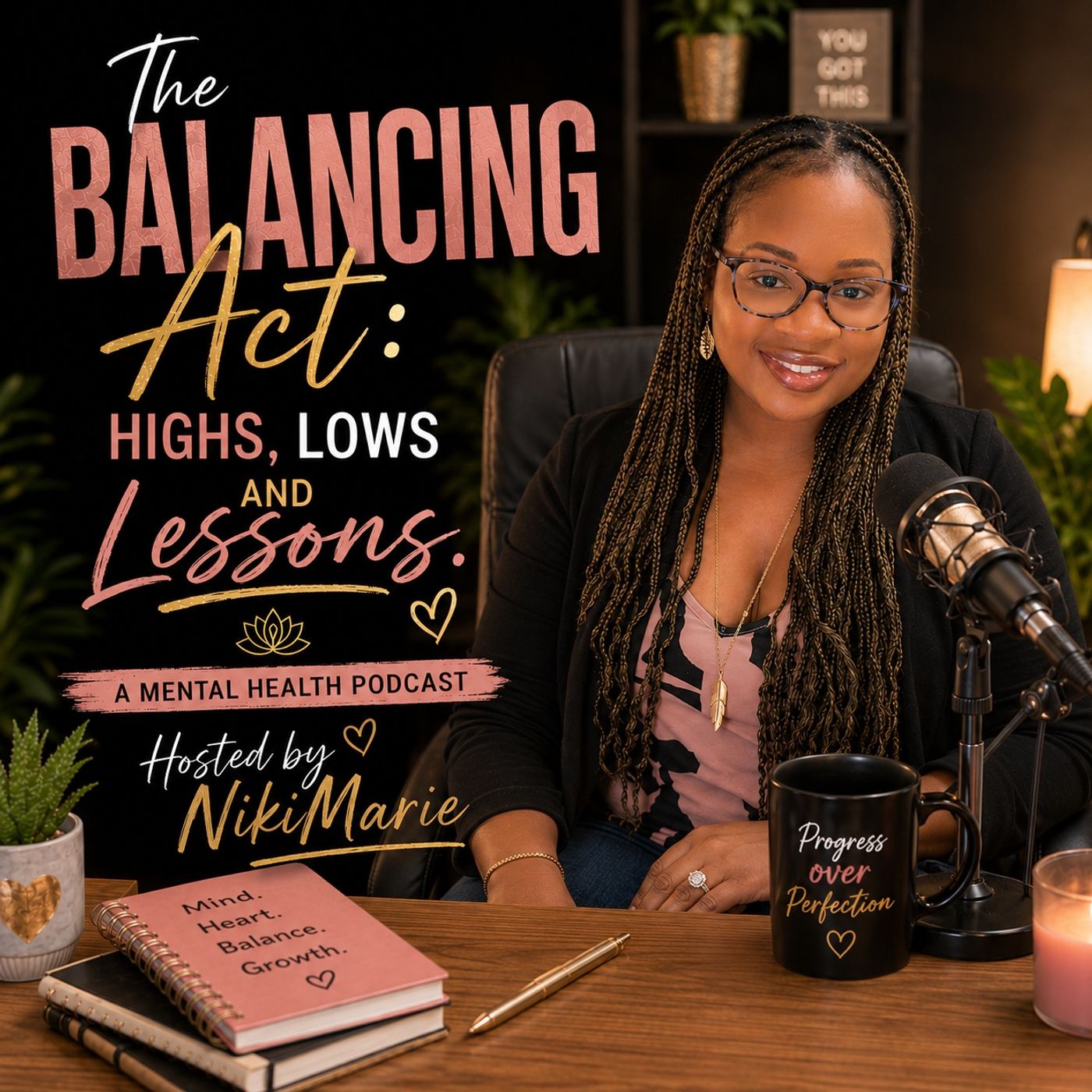
In this episode of The Balancing Act Highs Lows and Lessons, NikiMarie explores the quiet but powerful role self esteem plays in every part of our lives. From the inner voice shaped in childhood to the pressure of society and comparison, this conversation looks at where our beliefs about ourselves begin and how they follow us into adulthood. With honesty and compassion, NikiMarie unpacks how low self esteem shows up in our mental health, relationships and daily choices and how we can begin rewriting those messages with intention and truth. This episode is an invitation to slow down reclaim your voice and return to yourself with grace.
Hosted by NikiMarie, a Mental Health Advocate and Radio Personality for Nassau Community College Radio Station, 90.3 WHPC. The Balancing Act explores the highs, lows, and lessons of everyday life, reminding listeners that balance comes from presence, peace, and giving yourself grace.
0:06 Welcome back to the Balancing Act, highs, lows and Lessons. I'm your host, Nick and Marie, and today we're talking about something that quietly shapes every part of your life, your self esteem. Your self esteem is the foundation beneath everything and how you talk to yourself, how you love yourself, how you trust yourself, and how you rise after life knocks you down. People with healthy self esteem don't feel perfect. They simply believe these three things. I matter, my voice matters, and I am enough. But for so many of us, that inner voice sounds different. It whispers I'm not good enough, I don't belong. Something must be wrong with me. And the truth is that voice didn't start in adulthood. It started in childhood through the tone people use with us.
1:05 What they praised, what they dismissed, or whether we felt seen or overlooked. Today we're slowing down and tracing those messages back to the beginning. We're exploring how society, comparison, and early experiences shape your inner self esteem voice and how you can rewrite it with compassion, truth and intention. This episode is your invitation to rise, not by becoming someone new, but by returning to yourself self esteem is the foundation beneath everything else in your life. How you talk to yourself, how you love yourself, how you trust yourself, how you navigate the world, how you handle rejection or failure, and how you rise after life knocks you down. People with healthy self esteem aren't perfect. They don't make up every day feeling brilliant or beautiful, but they do believe I matter, I deserve to be here, My mistakes don't erase my worth. My voice matters, my needs matter, and I am enough. But someone with low self esteem carries a different inner truth. Their internal voice whispers I'm not good enough. I don't belong here. Everyone else is better than me. I shouldn't try because I'll fail. Why would someone pick me? Something must be wrong with me. This quiet internal voice shapes everything even when we don't realize it.
2:40 Self esteem doesn't suddenly appear when we become adults. It starts way earlier than most of us realize, long before we had the language to describe how we were feeling. In childhood. We are constantly paying attention, constantly absorbing the world around us. As I said to a friend of mine, I said, you know, kids are like sponges and they're constantly forming beliefs about themselves based on the people who raise us, who teach us, who influence us. Before we even heard the phrase self esteem, we were already taking in the tone of the adults around us, how they reacted to our emotions, whether home felt safe or unpredictable, how often we were encouraged, supported or comforted, and whether we felt seen, valued or quietly overlooked. Some children grow up in environments filled with warmth, patience, and affirmations, places where mistakes are treated as part of learning, and feelings are welcomed instead of dismissed. Other children, unfortunately, grow up in homes where comparisons or criticism or emotional neglect is the norm. And the thing is, even if our caregivers didn't mean any harm, the messages we receive still landed.
4:08 And those early messages don't stay in childhood. They travel with us, they grow with us, and they shape how we show up in the world as adults. So think about it as a child who constantly hears why aren't you more like your sister, or why aren't you more like your brother, starts to believe I'm not good enough. Who I am is always lacking. A child who hears stop crying, you're too emotional grows up into an adult who thinks MY feelings are a problem and I should keep them to myself. A child who is only praised when they achieve something good grades winning the game, being the responsible one learns that love is earned, but I have to perform to be worthy. And a child who rarely heard gentle words or affection becomes an adult who struggles to offer themselves the same kindness. They may look accomplished on the outside, but on the inside, that inner voice is cold. It's harsh or even unforgiving. And here's the part many of us don't realize as adults. We don't always make the connection. We don't look back and say, ah, that's why I feel this way. We just live with the symptoms of low self esteem and think that they're part of our personality. So we find ourselves asking why am I so hard on myself? Why does accepting a
5:41 compliment feel awkward or uncomfortable? Why do I shrink back in certain rooms even when I know I belong there. Why do I avoid opportunities that could help me grow? Why does rejection feel like the absolute end of the world and why, deep down does love feel like something I have to earn instead of something I deserve. When we start tracing these questions back to the beginning, we realize something powerful. Most of our self esteem wasn't chosen, it was learned. But as adults, we can choose to rewrite those old messages. We can rebuild how we see ourselves, and that's where the healing begins. But now here we go society. Society steps in and it doesn't matter how strong or ground do we think we are. The world around us has a way of whispering, nudging, and sometimes shouting that message that makes us second guess ourselves. From the time we're young, we're surrounded by images, trends, standards, and expectations that tell us who we're supposed to be and how we're supposed to look and what success or beauty is supposed to mean. And every few years the definitions shift. Curls are in, then straight hair is in, thick brows, then thin brows, heavy cauture, then no makeup fillers,
7:15 then natural beauty, glass skins, soft life, clean girl esthetic, that girl routines. The labels change, but the underlining message somehow stays exactly the same who you naturally are still isn't enough, and we internalize it whether we want to or not. We adjust, We adapt, We shape ourselves, sometimes slowly, sometimes dramatically, to fit whatever the current standard is. We change our hairstyle to match what's trending. We try new makeup routines because everyone online swears it's the look. We tweak our clothes, I'll poshure our poses. Ooh, get those angles or filters. And it's not until the image we're presenting stops feeling like the person we actually are. And here's the part we don't talk about enough. You can be confident and still feel the pressure. You can love yourself and still have moments when society makes you question if you're measuring up. Now, let me be clear, there's nothing wrong with enhancing your beauty. There's nothing wrong with exploring your style, you know, switching things up, or expressing yourself or enjoying aesthetics. There's nothing wrong with wanting to look good or feel good. The issue is not the change.
8:46 The issue is the intention behind the change. So the real question, the honest question, becomes am I doing this because it feels like me? Or because I want to be accepted. Society can make us shape shift, it can make us shrink, It can make us feel like we're always chasing some version of ourselves we've never actually met. When our self esteem is low, every choice becomes a performance. It's like a way to earn approval, validation, or a sense of belonging. But when our self esteem is healthy, that's when everything shifts. When self esteem is healthy, every choice becomes an expression, not a performance, not a disguise, not a survival strategy, just a reflection of who you actually are, not who you think you're supposed to be.
9:45 And a strong sense of self esteem doesn't silence society, nothing ever fully does. But it does give us the power to say, yeah, I can see the trends, I can enjoy them, but I don't have to lose myself to them. And that level of self trust, now that's real freedom. There's so many things that low self esteem can impact your mental health. Anxiety, depression, overthinking, fear of judgment, replaying conversations, predicting worst case scenarios. It can also affect your relationships, tolerating mistreatment, giving too much, shrinking to avoid conflict, taking crumbs, and calling it love, pushing people away before they can leave. It definitely affects friendships, work, school, physical health.
10:43 And we're talking about, you know, being the listener but never sharing, apologizing, constantly assuming your replaceable, staying quiet to avoid being a burden, doubting your abilities, avoiding promotions, shrinking in important rooms, settling for less emotionally eating, skipping meals, restless sleep, waking up tired because your mind never really rested. Low self esteem is sneaky. It even distorts positivity. Someone with confidence heres you did a great job and says thank you. Someone with low self esteem thinks they're lying. Oh, they must feel bad for me, what did I mess up?
11:29 Low self esteem turns blessing into threats, love into suspicion, and compliments into confusion. Now, getting into the headspace to rebuild your self esteem. That's important because before you can rebuild anything, you have to be in the right mental space to even start. And for a lot of people that's the hardest part. It's not the habits themselves, but getting your mind to slow down long enough to believe you're worth the effort. So before the daily practices, here's what helps you get into the headspace. Where healing becomes possible. The first is to slow down enough to notice your inner voice. You can't change the way you talk to yourself if you've never paused long enough to hear it.
12:19 Most people are walking around on autopilot, just working, commuting, scrolling, you know, doing, but not really checking. In just a few moments of quiet can reveal wow, I really talk to myself like this every day, so I mean awareness is definitely the doorway to rebuilding. The second is to give yourself permission to be a beginner. You won't suddenly wake up feeling confident. You won't believe every affirmation right away. You won't set a boundary and feel strong and unstoppable. But you have to allow yourself to start small, start messy if you need to are unsure. Permission creates space for growth. Third, release the idea that healing must look perfect.
13:10 I say this to my kids all the time. There's not one perfect person on this earth. Now. Some days you'll feel empowered, other days you'll feel like you're sliding backward, and that's normal. Self Esteem isn't a straight line. It's a pattern that you learn to rewrite over time. Four. Get honest about how much society has influenced your image. Denial never helped anyone, and it's hard to rebuild confidence when you're still measuring yourself against unrealistic standards body career, motherhood, relationships, timelines success. When you recognize these expectations were handed to me, they're not all mine, you create mental room to redefine who you want to be. Five. Choose one thing to start with. It's better to start than to not start at all. Now people get stuck because they try to change everything all at once, But your mind doesn't need a full life makeover. It just needs one shift, one new habit, one place to begin, and that's how real momentum builds. Once you're in the headspace, you're aware, you're open, you're honest and ready to take small steps. Then the daily habits have space to work. Now, rebuilding self esteem
14:41 isn't a quick fix. It's a practice. It's like a muscle, it's a commitment to showing up. Differently, these habits work best when you approach them from a place of compassion rather than pressure. So again, speak kindly to yourself. Replace harshness with truth. I made a mistake and that's normal. I'm showing up today, and that matters. I am worthy of healthy relationships. Set micro goals. Small winds create real confidence. So do things like drink water, take a short walk, complete one small task. Your brain response to completion, not perfection.
15:25 Use the mirror with compassion. Look at yourself the way you look at someone you care about and say, I'm proud of you. You're growing, You're learning. Practice boundaries. This is something I have to practice often. Practice boundaries. No is a full sentence. Protecting your piece is not rude, it's responsible. You also have to celebrate progress, even the tiny steps count. So getting out of bed, making a phone call, choosing rest, choosing yourself. Progress is anything that moves you toward the version of you you're intentionally building.
16:07 Curate your environment. Your surroundings influence your self esteem more than you think. When you're on social media, how about you follow accounts that uplift you. Limit your comparisons because not all those people that you're following are their true, authentic self. Keep people close who see your value even when you forget it. Move your body, stretch, walk, rest, nourish. Your body isn't something to fix, it's something to care for. You only have one body. I always tell my kids that I'm like you have one body, You better take care of it. Journal honestly ask yourself, what did I do well today? What challenged me? What did I learn?
17:01 Journaling helps you track your growth and rewrite negative beliefs. Get support if you can, because therapy helps you unpack the beliefs you developed during tough seasons and replace them with healthier ones. I do have to be honest. There have been seasons in my life where I didn't recognize myself, seasons where I questioned almost everything. And it wasn't because I wasn't capable, but because I was exhausted. I was overstretched and pouring into everyone else more than I was pouring into me. Having kids definitely changed me in ways that nobody prepared me for. Between the body changes and my priorities, even my identity. I mean, you go from being you to being mommy, mommy, mommy, and what feels like a single breath. And don't get me wrong, I love my kids. I love my kids. They are my heart walking around outside my body. But motherhood has a way of rearranging your life so completely that one day you look in the mirror and You're like, where did I go? Why don't I feel like myself anymore? Why is it so hard to give myself the same energy I give to everyone else? There were days I felt invisible inside my own life. I was taking care of kids, keeping the house moving, you know, pushing through work, showing up for everyone else except myself. Didn't even go to
18:33 a spa or anything like that. And in those moments, my self esteem quietly slipped into the background. I downplayed myself, I questioned myself. I worried too much about what others thought of me. I basically handed out microphones to people who had no business defining my worth. They had no business shaping how I saw myself. It wasn't that I lacked ability, it wasn't that I lacked strength. I was simply afraid. I was afraid of not being enough. I was afraid of failing the people who depended on me, Afraid that the new version of me after motherhood wasn't as valuable as the woman I used to be. Here's what I had to learn, slowly, painfully, and truthfully. I cannot build a healthy life on negative self talk. I cannot grow by abandoning myself. I cannot thrive if I let other people or society tell me who I am.
19:39 So I had to take my voice back. I had to remind myself that being a mother and being a woman with dreams, needs and desires are not in conflict. They coexist. And little by little I rose, like the phoenix rising from the ashes. I rose didn't come in loud moments. It didn't show up with fireworks or big announcements. It came quietly, almost softly. It showed up in boundaries of saying no. It showed up in choosing rest without guilt, and saying no without explaining or overly explaining, and giving myself grace when my body didn't bounce back the way I thought it should, and respecting myself enough to stop apologizing for simply existing, feeling, or taking up space. And that's how self esteem grows, not through perfection, not through pretending, not through comparison, but through grace, consistency, and truth and the beautiful part You can rise too, even if you're rising slowly, even if you're rising tired, even if you're rising while still carrying the weight of the world. Self esteem isn't about becoming someone new. It's about returning to the parts of you that motherhood, responsibility, or life's pressures made you forget. I'm still learning, still growing, still choosing me, even on the days when it feels hard, and that
21:12 in itself is strength, and that brings us to the end of today's conversation. Thank you for spending this time with me and forgiving yourself the space to reflect, unpack, and breathe. Remember your self esteem isn't fixed, its shaped, and it can be reshaped with intention, compassion, and truth. The voice inside you may have been influenced by childhood, society, or seasons of struggle, but it doesn't have to define who you become. As you move through the rest of your day, carry this with you. You matter, your needs matter, your story matters, and you are allowed to grow at your own pace. Let this episode be your reminder that returning to yourself is not a backward step, It's a powerful one. Thank you for tuning into the balancing act. Highs, lows and lessons. I'm your host, Nicko Marie. Until next time, keep rising, keep healing, and keep choosing you.